
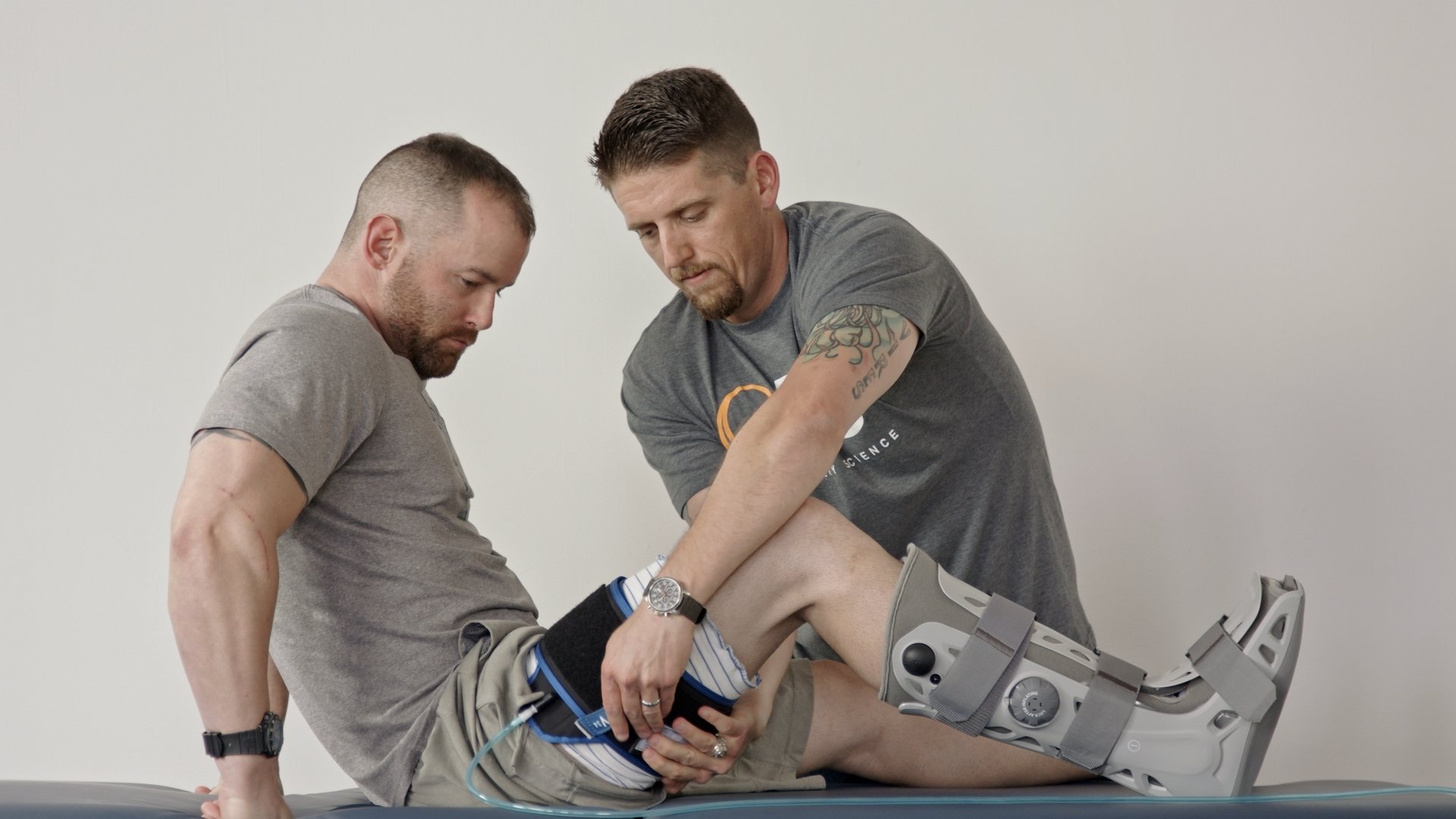
A recently published clinical review in Foot & Ankle Clinics of North America outlines how and why BFR should be integrated across the entire Achilles tendon repair continuum — from the moment of injury through late-stage return to performance.
Owens J, Drakos M, Kimbrell K. Achilles tendon rehabilitation — the role of blood flow restriction. Foot Ankle Clin. Published online February 2026. doi:10.1016/j.fcl.2025.12.009
The Problem Hasn't Been Fixed — It's Been Accepted
Achilles tendon rupture is one of the most consequential lower extremity injuries a clinician will manage. The incidence runs as high as 40 events per 100,000 persons annually, and it overwhelmingly strikes active adults in the prime of their training years. The standard recovery timeline — 6 to 12 months of limited mobility, up to a full year to regain strength — is well established. What is less often discussed is what happens after that.
The long-term outcomes data is sobering. Research by Leppilahti and colleagues found that 70% of patients have significant calf muscle atrophy at three years post-surgery. Heikkinen and colleagues reported strength deficits of 12–18% between the involved and uninvolved limbs at 13-year follow-up. These are not outliers. They reflect what happens when a muscle is forced into prolonged unloading without an effective countermeasure.
The root issue is structural: restoring muscle requires loads greater than 70% of a patient's one-repetition maximum, but a healing Achilles tendon cannot safely tolerate that kind of mechanical stress for months post-repair. Traditional rehab has never had a great answer for that gap. BFR does.
Key Stat: A recent survey of orthopedic surgeons found that 30.5% of BFR referrals were specifically for Achilles tendon repair — the clinical community has recognized the problem and is increasingly pointing toward BFR as the solution. |
Start Before the Surgery
One of the more important conceptual shifts in this paper is the framing of prehabilitation. Traditionally, prehab means a few weeks of physical therapy before a scheduled procedure. This review pushes that window back to the moment of injury — and the reasoning is grounded in physiology.
Injury itself triggers changes in muscle independent of disuse. Both the trauma and the subsequent unloading amplify the myostatin gene — a primary driver of muscle degradation that doesn't just waste tissue but progressively scars it down, making future restoration harder. The earlier an intervention begins, the more of that degradation can be slowed.
For patients in the immediate post-injury phase who cannot yet perform active exercise, passive (cyclic) BFR provides a viable strategy. Research by Kakehi and colleagues demonstrated that simply cycling cuff inflations — without any exercise — slowed the disuse-induced amplification of myostatin. It creates mild cellular swelling by briefly depriving the sodium-potassium pumps in muscle of oxygen, and that stimulus alone is enough to attenuate early atrophy.
Passive BFR Protocol — Cell Swelling Method
Parameter | Protocol |
Inflation Duration | 5 minutes on, then deflate |
Rounds per Session | 5 rounds |
Frequency | Twice daily |
When to Start | At injury; resume 3–4 days post-op |
Active Contraction Required? | No — passive only |
The other clinical value of early BFR is pain management. Ischemic preconditioning — a close relative of cyclic BFR — has been shown to temporarily reduce pain, making it a useful tool in those first critical days post-injury when pain and edema are the primary treatment targets. BFR also has potential analgesic effects through opioid and endocannabinoid pathways, which can allow earlier progression of therapeutic loading.
Why BFR Works: The Metabolic Logic
The mechanism behind BFR is worth understanding clearly, because it explains why it's uniquely suited to this clinical scenario.
When a pneumatic cuff is applied to the proximal limb and inflated to a percentage of limb occlusion pressure (LOP), it reduces arterial inflow and completely blocks venous return. The result is a hypoxic environment in the working muscle. The body responds by rapidly exhausting aerobic energy pathways and shifting to anaerobic metabolism, which generates metabolic byproducts — primarily hydrogen ions and inorganic phosphate — that cannot clear due to the cuff.
That accumulation of metabolites drives a fatigue response that forces the progressive recruitment of higher-threshold, fast-twitch (Type II) motor units. These are exactly the fibers that need to be recruited to drive hypertrophy — and they are typically only engaged under heavy loads. BFR gets there at 20–30% of 1RM rather than 70%+.
This is the clinical value proposition: the same anabolic signaling cascade, the same fiber recruitment, the same hypertrophic adaptation — at a fraction of the mechanical stress imposed on the healing tendon.
BFR and the Tendon Itself
An often underappreciated dimension of BFR in Achilles rehab is its effect beyond the calf musculature. Two distinct tissue-level benefits are worth highlighting for your clinical practice.
Tendon stiffness: Research — including work by Centner and colleagues — has demonstrated that low-load BFR training produces similar morphological and mechanical adaptations in the Achilles tendon as high-load resistance training. Specifically, tendon stiffness increases comparably between the two approaches. This matters because tendon stiffness is directly tied to energy storage and return capacity — a functional requirement for jumping, running, and sprinting. Gaining that adaptation without heavy loading is a meaningful clinical advantage in the early and intermediate rehab phases.
Angiogenesis: BFR upregulates pro-angiogenic factors, stimulating the growth of new blood vessels at both the repair site and the surgical incision. Improved vascularization accelerates the delivery of nutrients to healing tissue. This is a benefit that heavy loading at equivalent tissue healing stages simply cannot replicate.
In short, BFR is not just preserving muscle while the tendon heals — it is actively contributing to the healing of the tendon itself.
The Volume Problem: Why Standard Protocols Underdeliver
The gastrocnemius-soleus complex is built for endurance. Under normal daily activity — roughly 10,000 steps — it performs an extraordinary volume of work. That high-volume baseline is why conventional rehab protocols based on 3 sets of 10 consistently fail to drive meaningful hypertrophy in ATR patients. The dose simply isn't high enough.
Current evidence suggests a minimum of 10 sets per week of resistance volume is necessary to drive hypertrophy in most muscle groups. For the gastroc-soleus complex, given its normal daily loading demands, the requirement is likely higher. The BFR 30/15/15/15 rep scheme performed twice weekly generates 16 total sets across the week, with 8 working sets pushed to fatigue. That's the kind of volume that actually moves the needle for this muscle group.
BFR Resistance Exercise Parameters
Parameter | Recommendation |
Cuff Pressure | 60–80% of Limb Occlusion Pressure (LOP) |
Load | 20–30% of 1RM |
Rep Scheme | 30 / 15 / 15 / 15 |
Rest Intervals | 30 seconds (cuff remains inflated) |
Tempo | 2-second concentric, 2-second eccentric |
Frequency | Minimum twice weekly |
Weekly Volume | 16 total sets (8 working sets) |
Progression into resistance-based BFR should be gradual and individualized. Early in the post-op timeline, passive BFR and isometrics in the boot form the foundation. As tissue tolerance improves, exercises progress toward leg press toe raises, bilateral and then unilateral loading, with load parameters advancing accordingly.
Transitioning Out of BFR: Criteria-Based, Not Calendar-Based
One of the most clinically actionable principles in this paper is also one of the simplest: the decision to transition away from BFR should be driven by objective markers of strength and tissue capacity — not by how many weeks have passed since surgery.
By 12 weeks, the framework should include planning how to integrate traditional loading at 65%+ 1RM. But if strength deficits persist, BFR remains appropriate regardless of the postoperative timeline. Removing it prematurely because a calendar milestone has been reached is exactly the kind of time-based thinking that has contributed to the long-term deficits the research documents.
Practical transition strategies from the paper:
- Replace one BFR exercise at a time with heavy loading to maintain training volume while managing soreness from increased load.
- Alternate heavy loading days with BFR days (e.g., Monday heavy, Wednesday and Friday BFR) and gradually shift toward more heavy days as capacity allows.
- In later phases, short BFR training blocks (2–4 weeks) can be reintroduced to push through plateaus — evidence indicates BFR can drive adaptation in highly trained individuals when heavy loading no longer does.
BFR has been shown to increase Achilles tendon stiffness similarly to high-load resistance training, meaning there is no clinical downside to keeping BFR in the program longer — and meaningful upside if strength targets haven't been met. |
The Bottom Line for Your Practice
This review doesn't present a new intervention — BFR has been part of the orthopedic conversation for years. What it does is lay out a comprehensive, phase-by-phase framework for how to integrate BFR intelligently across the full ATR continuum, backed by the mechanisms, the dosing rationale, and the evidence to support each decision point.
A few takeaways worth carrying into practice:
- Prehab starts at injury. Passive BFR is an actionable tool even before weight-bearing is permitted.
- BFR addresses muscle, tendon, and vasculature simultaneously — it is doing more than preserving size.
- The calf demands higher training volumes than most clinicians are prescribing. The 30/15/15/15 scheme twice weekly is a minimum, not a ceiling.
- Transition decisions should be objective and individualized. Time-based protocols have produced the 13-year deficits the literature documents.
The full paper is available in Foot & Ankle Clinics of North America, published online February 2026 (doi:10.1016/j.fcl.2025.12.009). We encourage sharing it with referring surgeons and orthopedic colleagues — the discussion is one worth having across the care team.